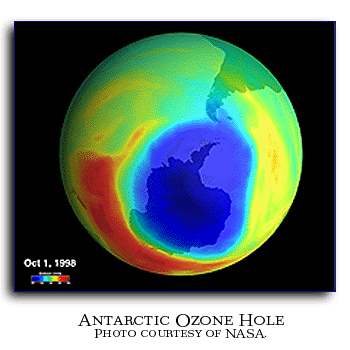
OTTAWA - Canadian scientists
who confirmed the link between ozone depletion and cell-damaging
ultraviolet rays have warned that the danger goes well beyond
human beings to crops, forests and animals.
They said their work enabled the first hard estimate of increases
that would occur over the next few decades in ultraviolet radiation.
They said science must now study the impact on biological organisms
that could affect agriculture and economic output.
"These increases on UV levels are important for studies
on the effects on our biosphere," Mr Jim Kerr, a scientist
with the government agency, Environment Canada, and co-author
of the ground-breaking study, told a news conference on Friday.
The study, conducted in Toronto, provides the first conclusive
evidence that depletion of the atmosphere's ozone layer exposes
populated areas of the Northern Hemisphere to greater ultra-violet
radiations.
"We were able to link the increase in ultraviolet fairly
accurately to the decreases in ozone, because they were so large,"
he said.
The ozone layer shields the Earth from over 90 per cent of ultraviolet
light, which is invisible and can cause skin cancer and eye damage,
At certain wave-lengths, called UV-B it can be harmful to virtually
all biological processes.
Mr Ralph Daley, a biologist at Environment Canada's National
Water Research Institute, said that exposure to excessive UV can
cause genetic damage to plants, disrupt reproductive processes,
alter food chains and cause the displacement of entire species.
"This study takes us from the hypothetical realm to the
realm of reality," he said.
"If one does a conservative extrapolation, by the year 2005,
when the ozone hole is expected to be at its maximum, we could
have as much as a 50 per cent increase in the level of UV-B."
Mr Daley said such increased levels of radiation had been shown
to alter biological organisms experimentally exposed to UV-B.
He said UV light could alter the DNA structure of organisms and
elaborate photo-chemical repair processes.
"We humans are able to adapt and protect ourselves with
sunscreens … the more serious consequences are ecological,"
he said.
"The scientific challenge now is to determine which organisms
are affected most dramatically and which not." - REUTER.
|
 : Articles